Maybe your lobes were done years ago at a jewellery counter, in about four seconds, with a click you still remember. Now you want a nose, a helix or a second lobe, and you are quietly wondering whether it is the same thing. That is the piercing gun vs needle question, and it deserves a plain answer rather than a lecture.
So here it is. We will walk through what each tool is, what Public Health Ontario says a gun may be used for, what professional piercers say, and what actually happens when you sit in our chair. And nobody is judging the four-second click. It was a perfectly normal choice at the time, and your lobes are not in trouble.
Piercing gun vs needle: the short version
A piercing gun pushes a stud through your skin. A piercing needle makes a clean opening first, and the jewellery follows it in. That is the core difference, and almost everything else in this article grows out of it.
Public Health Ontario puts it in nearly those words. In its 2024 guide to the risks posed by piercing guns and devices, it says all piercing devices create the piercing by forcing jewellery through the skin, while a sterile needle creates a tunnel for the jewellery to follow. Neither sentence is meant to scare you. They are two ways of making a hole, and the rest is about where each one belongs.
What a piercing gun actually is
"Gun" makes it sound far more dramatic than it looks. Most are a small handheld device with a trigger, holding a stud on one side and its clasp on the other. Squeeze, and the stud goes through the lobe and snaps into its backing in one motion.
According to Public Health Ontario, the traditional kind is spring-loaded. Older versions used fixed parts that, in PHO's words, cannot be effectively cleaned and sterilized, so newer models use single-use disposable pieces or single-use cartridges. There are also hand pressure devices that load a sterile, single-use cartridge holding the jewellery. So "a gun" today can mean a few different things, and the newer ones are cleaner than the ones many people remember.
What they all share is the stud. It is designed for the fleshy part of an earlobe, and PHO notes these devices cannot be adjusted for the different tissue thicknesses found elsewhere on the body.
What a piercing needle actually is
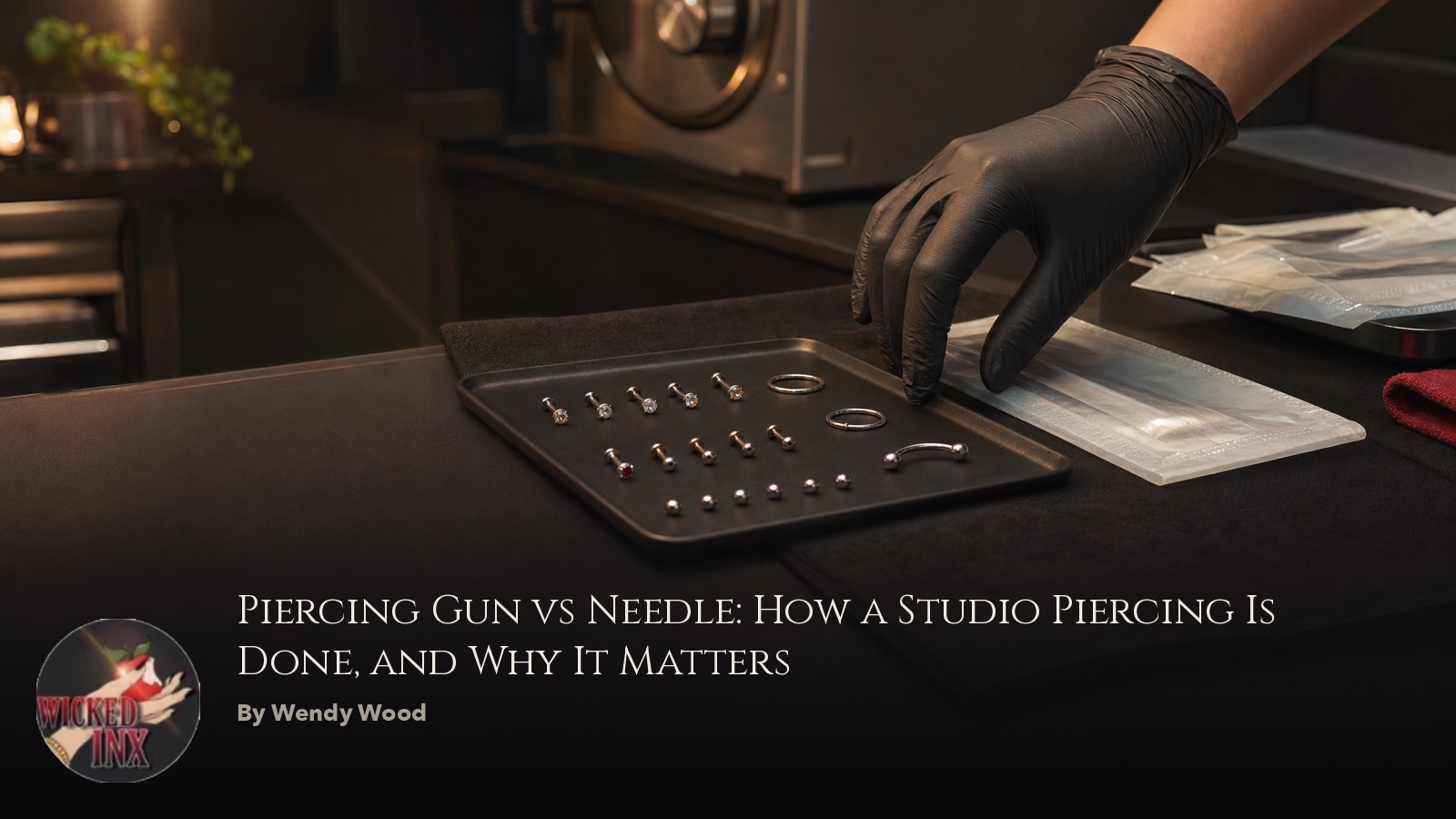
A piercing needle is hollow, very sharp, and used once. At a studio it comes out of a sealed, sterile package, makes the opening, and the jewellery is passed through right behind it. Public Health Ontario describes this as the traditional method: a single-use needle perforates the skin, and the jewellery goes into the tunnel it created straight away.
Because the needle and the jewellery are separate, the jewellery can be chosen for you: the right length for your anatomy, the right style for the spot, the right metal. PHO notes that the length and gauge of jewellery for a body piercing varies with where it goes, and that longer jewellery may be used where swelling is a concern. Gauge, if the word is new, just means the thickness of the jewellery.
It also means a needle can go places a stud was never designed for: cartilage, nostrils, a septum, and the rest of the list on our piercing page.
Where Ontario says a piercing gun can go
This is the part most people have never been told. Public Health Ontario's infection prevention guide for personal service settings says ear piercing guns and devices are not to be used on any other part of the body except the ear lobes, fleshy part only. PHO repeats that line in its piercing guns guide.
So the lobe, the soft bit at the bottom of your ear, is where an ear piercing gun belongs. Not the upper ear, not the tragus (the little flap in front of your ear canal), and not a nose. That is not our opinion and it is not a studio being fussy; it is Ontario's public health guidance.
There is one wrinkle worth being straight about. PHO notes that some devices are made specifically for the nostril or the navel, and says that when those are used according to the manufacturer's instructions, current Ontario guidance neither prohibits nor endorses them. So you may come across one. They are simply not what a professional piercer tends to reach for, which brings us to the piercers.
Why the earlobe is the exception, and cartilage is not
Your lobe is soft tissue. Almost everything above it on the ear is cartilage, the firmer, bendy stuff that gives your ear its shape. Public Health Ontario explains that cartilage has a poor blood supply, faces a different set of injury risks, and that piercings through it can take longer to heal.
PHO also notes that because a gun cannot adjust for different tissue thicknesses, jewellery used somewhere it was not designed for can become embedded, and that documented infections have followed ear piercing devices used on cartilage. That is why the lobe-only line exists.
None of this is meant to put you off a helix or a conch. It is the reason they are done with a needle, carefully, by someone who has done thousands of piercings. At our shop, that is Wendy, who handles our face and body piercings.
What professional piercers say about guns
The Association of Professional Piercers, a professional body for piercers, is blunter. Its position on piercing guns says APP members may not use reusable ear piercing guns for any type of piercing procedure. Its reasons: plastic guns cannot be autoclave sterilized (an autoclave is the steam sterilizer studios use), the effect on the body is, in its words, more like a crush injury than a piercing, and the studs are too short for some earlobes and most cartilage.
Public Health Ontario notes the same thing from the other side: professional piercers in tattoo and piercing studios almost always pierce with a needle, because they see it as the less traumatic technique. That is about as close to agreement as a whole trade gets, and it is why a studio piercer may look slightly puzzled if you ask for a gun on your nose.
What the research does and does not show
We would rather be honest than win an argument, so here is the other side. PHO points out that there is limited research comparing the infection risk of different piercing methods. One small lab study it cites pierced the upper ear cartilage of cadaver ears with two spring-loaded guns, a hand pressure device and a needle, and found no significant difference in cartilage damage between them. PHO adds that the sample was small and the study did not report an estimate of statistical power to back its conclusion.
So we will not tell you a needle is guaranteed to hurt less or heal faster. What the guidance does agree on is simpler: guns belong on the fleshy lobe only, older fixed devices cannot be properly sterilized, and a needle lets the jewellery be fitted to you rather than you being fitted to a one-size stud. Those are the reasons we pierce the way we do.
Ear piercing with a gun vs a needle: the jewellery matters too
People tend to focus on the tool, but for ear piercing with a gun vs a needle, the jewellery that goes in is half the story. PHO describes ear piercing jewellery as coming in fewer lengths and gauges than body jewellery, and usually fastening with a butterfly clasp that holds the stud against the back of the lobe.
With a needle, the first piece of jewellery is picked for the spot. PHO's guide says jewellery for body piercing should be made of biocompatible material, single-use and sterile until it goes in, and smooth, free of nicks and scratches. It also says jewellery designed for ear lobes is not to be used on other parts of the body.
At our shop, fresh piercings get medical-grade steel or titanium, and the jewellery is included in the price. If you have a nickel or metal allergy, tell us first and we will match you.
What happens at our chair
Here is how a piercing goes at Wicked Inx in Hamilton, from the moment you sit down.
- We talk first. What you want, where, and whether any metal has ever given you trouble.
- We check the placement on you. Every ear and nose is a little different. If a placement is not safe for your anatomy, or today is not the day, we tell you straight and reschedule.
- We open the needle in front of you. A brand-new, pre-sterilized needle comes out of its sealed package where you can see it, and goes straight into a sharps container afterwards. Needles are never reused, on anyone, ever.
- We go at your pace. Wendy tells every first-timer the same thing: close your eyes, take a deep breath, you're doing great.
- You leave with aftercare. Spoken, and written on the card we send you home with.
If aftercare is the bit you are nervous about, our piercing aftercare do's and don'ts walks through what to do once you leave, straight from that card.
How to ask any shop what they pierce with
"What do you pierce with?" is a completely normal question, and it gets a normal answer. You are allowed to ask it before you book, when you arrive, or with the needle packet sitting in front of you. A few more worth asking:
- Is the needle single-use, and will I see it opened?
- What is the jewellery made of, and is it included in the price?
- Will you check the placement on my ear or nose before we start?
- What aftercare will I go home with?
If you get a clear, friendly answer to all four, you are in good hands. If the answers are vague, it is fine to say thanks and leave. That is not rude; it is your body, and you get to be choosy about who pierces it.
Your next piercing, done with a needle
If your lobes were done years ago and you are wondering what to add, our guide to which piercing to get next goes through the options, from a second lobe to a helix to a nostril, and what each one involves. Bring your old lobes along; we will look at where they sit and plan around them.
When you are ready, book your piercing online, or call us on (905) 544-1209 and ask what we pierce with. We will tell you, and then we will open it in front of you. Saturdays are half price for piercings, pre-booked only, so if you like a bargain, plan ahead.
Nervous? First timer? Coming back for your next one after a four-second click years ago? You are exactly who we are best with.