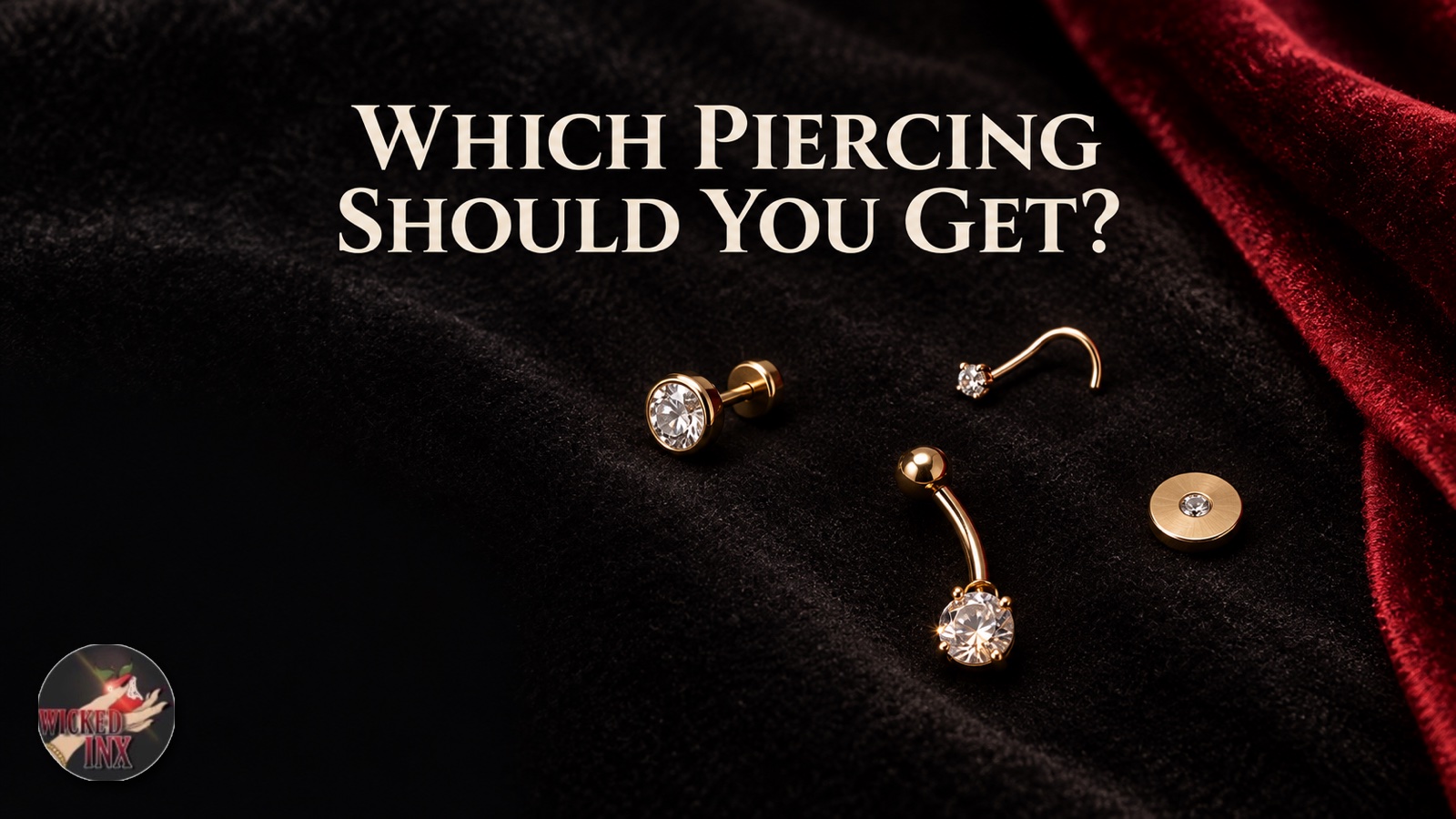
Most people who message us do not actually want "a piercing." They want a specific look, and they are quietly hoping somebody will tell them which spot gets them there without it turning into a whole ordeal. That is a completely normal way to arrive.
So here is the plain version. We are a small studio doing body piercing in Hamilton, on Barton Street East, and below are the spots people ask us about most: what each one is actually like, what we look at before we mark it, and what goes into the price before you have to ask. Skip to the part of your body you have been thinking about. That is what it is laid out this way for.
Start with the spot, not the photo you saved
Nearly everyone brings a picture, and we like that; it tells us the look you are chasing faster than a paragraph would. The catch is that a photo shows one person's ear or one person's stomach, and yours is shaped differently. So the first thing that happens is not the needle. It is a look at the actual anatomy in front of us, and a conversation about whether the thing in the photo will sit well on you.
Most of the time it will. Sometimes it will not, and the honest version of that answer is worth more than a booking. Anatomy gets a vote here, and it usually votes early.
Ear lobes: where most people start
Lobes are the classic first piercing and there is no shame in them being your entire plan. The tissue is soft, the placement is fairly forgiving, and it is the one area where you can go one, two or three a side and build it out over time instead of deciding everything at once.
If you are adding to lobes you already have, say so at the start. Existing holes sit exactly where somebody else put them, sometimes years ago at a jewellery counter with a gun, and the next one has to work with that spacing rather than fight it. That is a two minute conversation up front, and it is the difference between a stack that looks deliberate and one that looks like it happened by accident.
Ear cartilage: same ear, different job
The upper ear and the inner ridges are cartilage, which is stiffer, thinner in places, and far pickier about angle than a lobe. People come in asking for a helix, a tragus or a conch, because that is what the internet calls them. What we are looking at is whether the ridge on your ear is deep enough, thick enough and sitting at an angle that will hold jewellery straight rather than pull it sideways.
Sometimes the exact millimetre in your photo will not work on your ear and a spot slightly over will look better and behave better. We would rather say that while you are still standing at the counter. Aftercare matters for every piercing, cartilage included, and it is the part that carries on long after you leave; we go through it with you in person, and the same advice is written down in our piercing aftercare do's and don'ts if you would rather read it before you book.
Nostril: small, visible, and less dramatic than people expect
The nostril is the single most asked about piercing we deal with, and the worry attached to it is almost always the same one: that it will be loud. On most faces a small stud reads as a detail rather than an announcement, which is why people are usually surprised by their own photos afterwards.
What actually decides a nostril is the shape and thickness of your nostril itself, and what you do all day. Glasses, a mask at work, sport, sleeping face down: none of those rule it out, they just change what we would put in and where. Tell us about your day and it stops being a guess.
Septum: the one you can tuck away
The septum sits between the nostrils, and it is the piercing on this page you can genuinely hide. Flip the jewellery up and it disappears. If your workplace has opinions, or you want to try the look before you announce it to your family, this is usually the one people mean.
Everybody's septum is shaped a little differently, so this is one we mark carefully and check with you before anything happens. Placement is doing all the work on a septum. Get it right and it sits level and looks like it was always there; get it rushed and you will notice every time you look in a mirror.
Navel: the piercing anatomy shouts loudest about
A belly button piercing goes through the small lip of skin above the navel, and that lip has to actually be there, with enough depth and the right angle to hold jewellery without constant tension on it. That is not a matter of body type or size. Plenty of people who assume they are not suited turn out to be a great fit, and the reverse happens too.
So this is the one where we will look, tell you what we see, and give you a straight answer. If it is a good fit, brilliant. If it is not, we will say so and talk about what else would give you a similar look. We would rather lose the appointment than put jewellery somewhere that is going to fight you every day.
Dermals: one anchor, flat skin, and a plan for later
A dermal is a different animal from everything above. There is no entry and exit; it is a single anchor that sits under flat skin with a top that screws onto it, which is how you get a piece of jewellery to look like it is sitting on a collarbone or the back of a hand.
Two things are worth knowing before you commit. It lives on skin that moves, stretches and gets caught on towels and seatbelts, so placement is a practical decision as much as an aesthetic one. And taking one out later is its own small procedure rather than something you do at home with tweezers. Dermal removal is something we do properly, and it is a much better conversation to have before you get one than after.
Still not sure? Here is how we narrow it down
When someone sits down and says "I want something but I do not know what," we ask three questions and it usually sorts itself out in about a minute.
- Where do you want people to look? Face, ears, or somewhere only you and a chosen few will see.
- What does your day look like? Uniform, helmet, mask, sport, sleeping position, the works.
- How much do you want to think about it? Some spots are quietly low maintenance and some want your attention. Both are fine; knowing which you want is the point.
If you are a visual thinker, have a scroll through our gallery first and bring in the two or three that keep pulling you back. That is a better starting point than a description every time.
What moves the price of body piercing in Hamilton
We do not publish a price list and we are not going to invent one in an article. What we can do is tell you what the number is made of, which is the part people actually want and rarely get.
- The spot. A lobe and a dermal are not the same amount of work, so they are not the same price.
- The jewellery you choose. The jewellery is included, and what you pick from what we have is the piece that moves the total most.
- The day you come in. Saturdays are half price on piercings and they are pre-booked only, which is the one lever entirely in your hands.
Then book, or email, and you get a straight number for the thing you are actually asking about before you commit to anything. Nobody here benefits from a surprise at the counter.
Why the jewellery is in the price
At a counter that pierces on the side, the stud is the product and the piercing is the thing that gets you to buy it. Here it is the other way around. The jewellery is included in the piercing price, because a fresh piercing with an afterthought in it is half a job, and we would rather put implant grade steel or titanium in on day one than sell you a nicer one later.
The Association of Professional Piercers, in its guidance on jewellery for initial piercings, lists implant certified titanium that is ASTM F-136 compliant and steel that is ASTM F-138 compliant among the materials it recommends, and it makes the point that fit matters alongside material: a piece that is too tight for your anatomy causes problems of its own. That is why we fit the piece to you at the appointment rather than handing you a sealed box. You can see the service and what it covers on our piercing page.
What the appointment is actually like
We are open Wednesday to Saturday, 1:30 to 5, and it is appointments only. When you sit down we look at the spot, mark it, and then show you the mark and wait. You are allowed to say no to it, and plenty of people move it a hair before they say yes. The needle comes out of a sealed single use package, opened in front of you, because that is the only version of it worth doing.
Piercing studios in Ontario are what Public Health Ontario calls personal service settings, and it says local public health units inspect them for infection prevention and control practices, tattooing and other body modification included. That is the floor everyone stands on, not a selling point. The rest is Wendy talking you through it in the voice she uses for every first timer: close your eyes, take a deep breath, you are doing great. The most common thing people say afterwards is that it was over faster than the paperwork.
Come and pick one
If you got this far, odds are one section on this page was yours and you already know which. Bring the photo, bring your ID, bring the question you feel silly asking, because we have heard it and it is not silly. Book an appointment and tell us the spot you have been thinking about, and if Saturday is the one you want, give yourself a few days of run-up. Those go quickly.