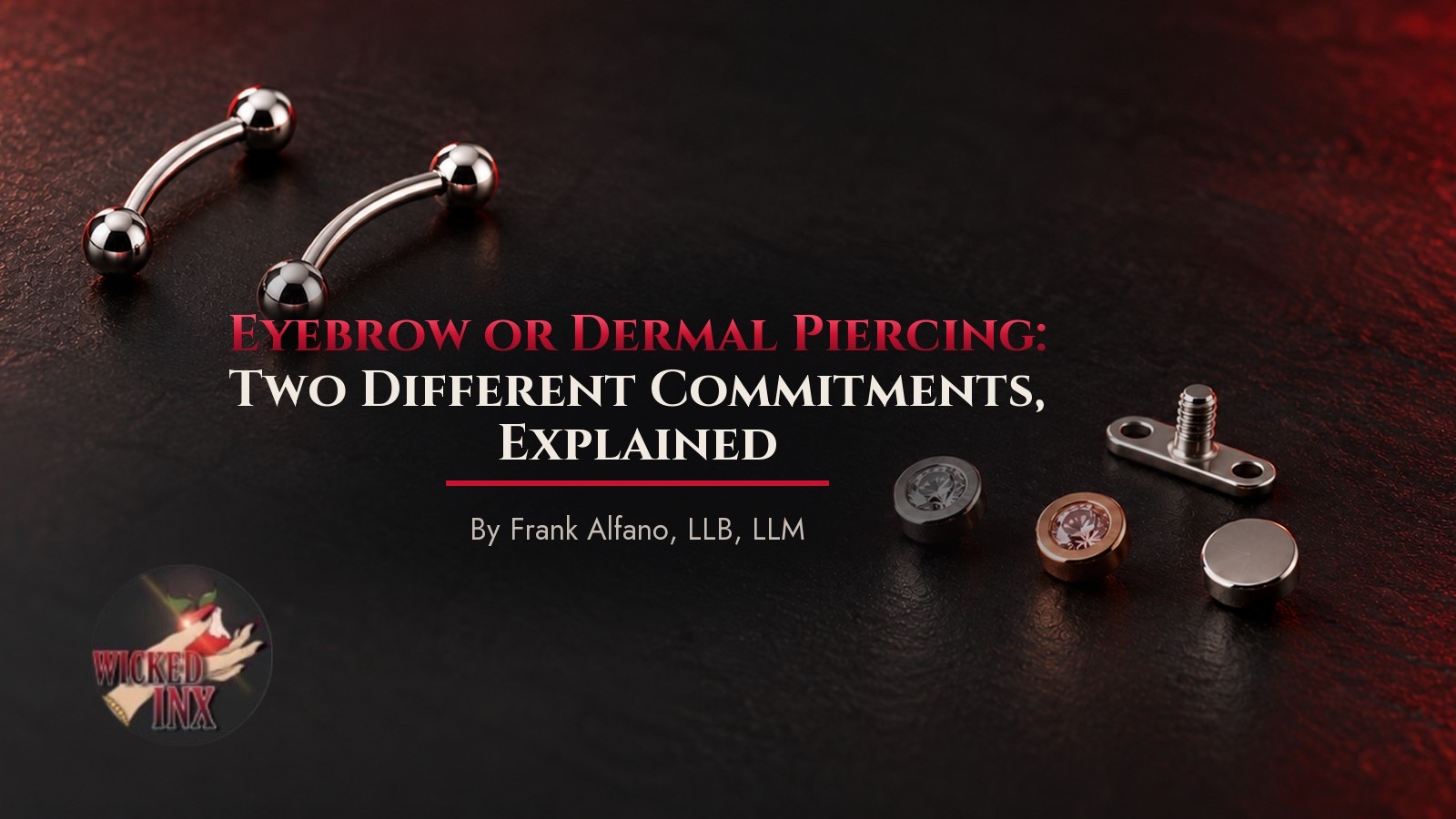
You want a little sparkle somewhere new. Maybe on your face, maybe on your collarbone, maybe right at the edge of your eyebrow. You have been scrolling, and two words keep coming up: eyebrow and dermal. They look a bit alike in photos. They are not the same thing at all.
This guide explains the difference the way we would at the counter of our Hamilton shop. We will cover what an eyebrow piercing is, what a dermal piercing is, how the jewellery differs, what changing or retiring each one looks like, why surface piercings can move, and the questions worth asking before you book.
Eyebrow or dermal: the short version
An eyebrow piercing goes in one side of a small pinch of skin and out the other. It has an entry and an exit, and the jewellery runs through the skin between them, usually with a little bead or ball showing at each end.
A dermal piercing has only one opening. A tiny base sits just under the surface of the skin, and the only thing anyone sees is a single top sitting flat, like a gem resting on the skin. That is why dermals can go on flat areas where you cannot pinch up a fold of skin, such as a cheekbone, the chest or the lower back.
Neither is the "easy" one or the "hardcore" one. They are just two different commitments, and the right choice depends on the look you want, your anatomy, and how you live.
What an eyebrow piercing actually is
An eyebrow piercing is a vertical-ish piercing through the skin at the edge of the brow, most often toward the outer end. The jewellery is usually a small curved barbell, which follows the curve of the brow, with a bead at each end.
The Association of Professional Piercers (APP), a professional body for piercers, says in its guide to jewellery for initial piercings that rings are best for some areas and straight or curved bars for others. It also says first jewellery must be the right length for your anatomy and the placement, and that jewellery that is too thin can be treated by the body like a splinter. That is the kind of thing we are measuring and checking before we start, and it is why your eyebrow jewellery is fitted to you rather than picked off a display.
Day to day, an eyebrow sits right where your hands, towels, hoodies and pillows go. Most of looking after one is simply not catching it.
What a dermal piercing actually is
A dermal piercing, also called a surface anchor or microdermal, is a single-point piercing. The APP explains it in its piercing FAQ: a tiny ornament is inserted into a single opening made in the tissue with the same tools used for body piercing, and that one opening is both the entrance and the exit.
The APP also says that when a surface anchor is properly performed by a skilled practitioner, it is no more risky than an ordinary body piercing, and it takes no longer to perform or to heal. It considers surface anchors to be body piercings. So if you were picturing something dramatic, it is a smaller deal than the internet makes it look.
What you see afterwards is just the top: a little gem, a flat disc, or a shape, sitting snug against your skin. What you do not see is the small base underneath that holds it in place.
Anti-eyebrow and other in-between options
Then there is the anti-eyebrow, which confuses everybody, because it is not on the eyebrow. It sits on the upper cheekbone, below the outer corner of the eye. Depending on your anatomy and the look you want, it can be done in different ways, and that is a conversation to have in person.
People also ask about back dermals, the pair of little gems at the lower back, and other surface placements like the collarbone and the side of the face. If one of these is on your list, mention it when you book. Whether a placement suits you depends on your anatomy, and we would much rather look properly and tell you honestly than promise you something that will not sit well.
For a wider look at the whole menu, from lobes to navels, our guide to which piercing you should get walks through the options first-timers ask about most.
How the jewellery differs
This is where the two really part ways.
- Eyebrow jewellery passes all the way through. Usually a curved barbell with a bead at each end. Later, once healed, people sometimes change the beads or switch to a different style.
- Dermal jewellery comes in two parts: a base that sits under the skin, and a top that screws onto it. You only ever see the top.
Material matters for both. The APP's initial-jewellery guide lists certain grades of steel, implant-certified titanium, niobium, solid gold that is 14k or higher and nickel- and cadmium-free, platinum and some types of glass as suitable for fresh piercings. It says gold-plated, gold-filled and vermeil pieces are not acceptable for fresh piercings, because the thin gold layer can wear or chip off.
At our shop, fresh piercings get medical-grade steel or titanium, and the jewellery is included in the price of your piercing. If you have a nickel or metal allergy, tell us before we start and we will match you.
Changing the top or the bar later
Here is the practical difference most people do not think about until later.
With an eyebrow, a jewellery change means taking the whole bar out of the piercing and putting a new one in. Once you are healed, that can be a simple job, but the first change is best done with us so we can check the fit.
With a dermal, the base stays put and only the top changes. The APP's initial-jewellery guide says the threaded top of a surface anchor may be changed, and that removing the base causes the loss of the piercing, so this is not normally done. We swap dermal tops at the shop by appointment, which is handy if you like to change your look with the seasons, or your outfit, or your mood.
Please do not go at a dermal top with your fingernails or pliers at home. Bumping or levering the base is exactly what you want to avoid. Book a quick appointment instead.
Why surface piercings can move, as the APP explains it
We are going to be straight with you here, because you deserve to know before you book rather than after.
Any piercing can migrate or reject. In its FAQ, the APP describes migration as a piercing moving from where it was placed and settling somewhere new, and rejection as the jewellery being pushed out of the body completely.
It says a piercing is likely to migrate when unsuitable or insufficient tissue is pierced, or when jewellery is too thin, too small or of poor quality. Migration and rejection can also follow harsh aftercare products, poor health habits, and physical knocks or emotional stress during healing. And it says that sometimes, even when everything is done properly, a piercing will migrate or reject for no known reason.
For dermals specifically, the APP calls surface anchors "long-term temporary," meaning they are not expected to last forever. It says the body is likely to reject this type of adornment at some point, generally somewhere between six months and a couple of years, pushing it out much like a splinter. It also says a longer lifespan is more likely in low-movement areas that are less exposed to knocks and snags, and that scarring is generally minimal because the base under the skin is small.
That is not meant to put you off. Plenty of people love their dermals and treat them as a sparkly chapter rather than a forever thing. It just means picking a calm spot matters, and so does treating it gently.
What retiring each one looks like
Sooner or later, a lot of piercings get retired. Here is how the two compare.
An eyebrow can be retired by taking the jewellery out. The APP's FAQ says that once jewellery comes out, many piercings shrink or close quickly while some stay open, and that a piercing can leave a mark such as a small scar. If you are unsure whether you are really done with it, talk to us before you take it out.
A dermal is retired by removing the anchor, and that is a job for a piercer. The APP's FAQ says surface anchors can be safely removed with standard piercing tools and techniques, and we remove dermals at the shop. Please do not try to dig one out yourself. Book a time, tell us it is a removal, and we will talk you through it first.
Where your skin and lifestyle come in
Before you fall in love with a placement, think about your actual week:
- Do you wear glasses? Frames can sit close to an eyebrow or anti-eyebrow.
- Do you play contact sports or wear a helmet? Knocks and straps are hard on surface work.
- How do you sleep? Side sleepers press a face piercing into the pillow all night.
- What does your work allow? A dermal top cannot be slipped out for a shift the way some jewellery can.
- Waistbands and bra straps. Back dermals and chest dermals sit right where clothes rub.
None of these is a dealbreaker on its own. They are just the details we will ask about, so we can suggest a spot that fits your life as well as your face.
What happens in the chair
Nervous people always want to know exactly what happens, so here it is, start to finish.
First, the paperwork: photo ID and a signed consent and health-history form. Then we talk about the placement. We look at your anatomy with you, with a mirror, and talk through exactly where it will sit. If it is not quite right, we move it. Nothing happens until you are happy with where it sits.
Next, the setup. Every piercing uses a brand-new, pre-sterilized needle opened in front of you, and it goes straight into a sharps container afterwards. Reusable tools are cleaned and sterilized in an autoclave and only opened at your appointment. Hands are washed, fresh gloves go on, and the work area is disinfected and covered between clients.
Then the piercing itself, which is over far faster than the waiting beforehand. We tell you before each step, and we talk you through a slow breath as it happens. Afterwards, we check the jewellery, go through your aftercare, and hand you the card to take home.
And if something is not right on the day, say you are unwell, or the placement is not safe for your anatomy, we will tell you straight and reschedule. Your health beats a sale, every time.
Questions to ask before you book
In Ontario, piercing studios are personal service settings under Ontario Regulation 136/18, and they are inspected by the local public health unit. Section 6 of the regulation says that before an invasive procedure, the person seeking it must be given an explanation of the procedure and information about any risks. That conversation is your chance to ask anything at all, and we are happy to go through it.
Here are good questions to bring:
- Does my anatomy suit this placement, or would a spot nearby sit better?
- What jewellery will go in on the day, and what is it made of?
- How do I look after this placement day to day?
- When can I change the top or the bar, and do I book that with you?
- What should make me call the shop?
Before you leave, you get our aftercare in writing. Our piercing aftercare do's and don'ts sets out the routine straight from the card we hand out, and that card is the plan to follow. If anything about your piercing worries you, call the shop at (905) 544-1209, or see a doctor or pharmacist.
Booking your eyebrow or dermal piercing in Hamilton
We are on Barton Street East in Hamilton, open Wednesday to Saturday, 1:30 to 5 PM, and every service is by appointment. Our shop policy is 18 or older on your own; under 18, a parent or guardian must be present with ID. Everyone brings photo ID and signs a consent and health-history form before we start. Every Saturday, piercings are half price, pre-booked only.
When you request your appointment, tell us whether you are leaning eyebrow, dermal or anti-eyebrow, and where. If you are torn, say that too. We will look at your anatomy with a mirror and help you decide before anything touches your skin. You can see the placements we do on our piercing page, and then request your appointment when you are ready.
Nervous? First timer? You are exactly who we are best with.