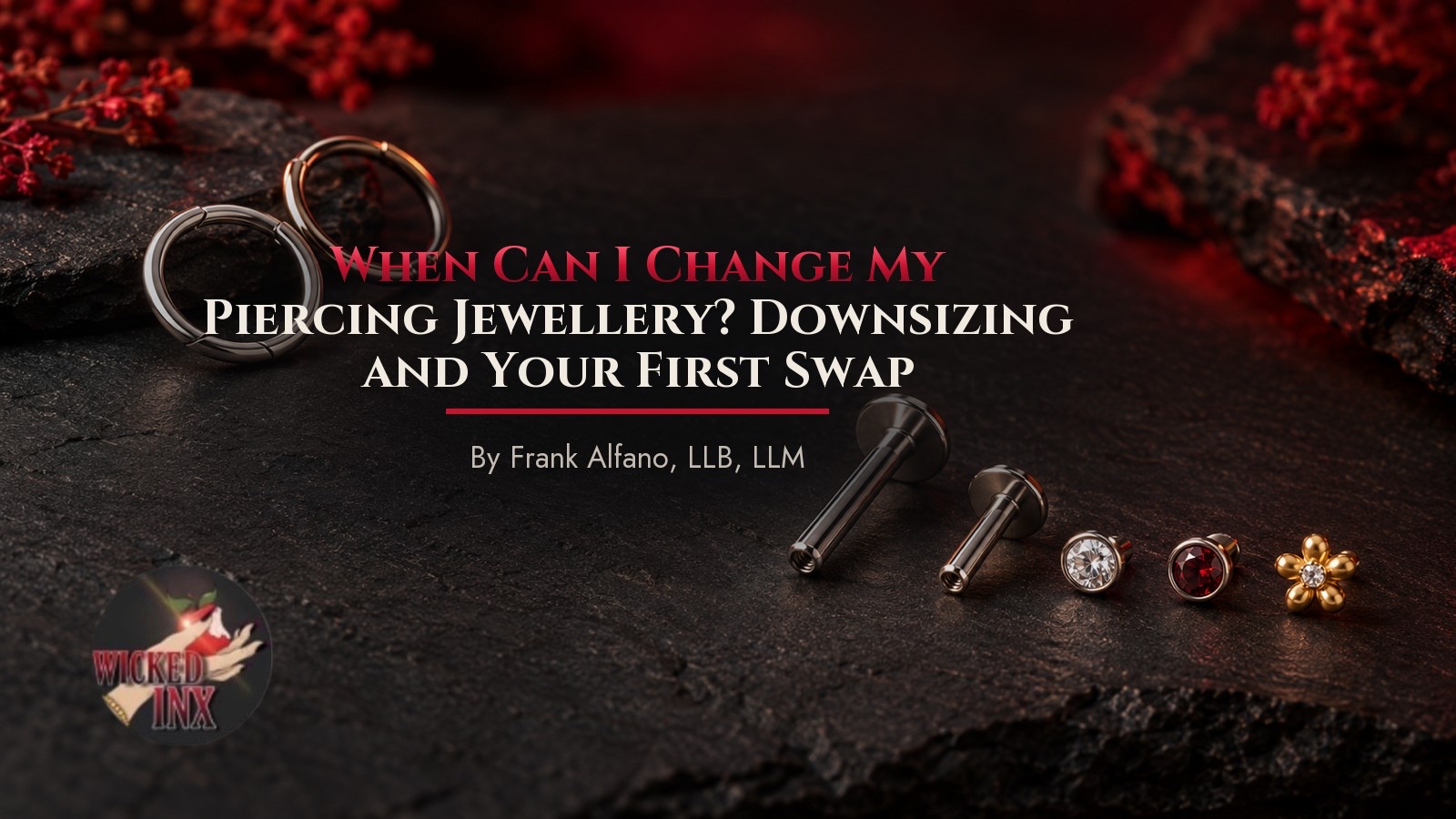
You love your new piercing. You have caught yourself admiring it in every mirror you walk past. And somewhere around day three, you started shopping for the next piece of jewellery, because the one it came with is, let us be honest, a little plain and a little long.
We get it, and we love the enthusiasm. This guide is the plain-English answer to the question we hear most after a piercing: when can I change my piercing jewellery? We will explain why your first piece is chosen for healing rather than looks, what downsizing means, why swelling sets the timing instead of the calendar, and why your first swap is best done back at our Hamilton shop.
Why your first jewellery is not your forever jewellery
The jewellery that goes in on the day of your piercing has one job: to help a brand-new wound heal well. Looking cute is a bonus. That is why it is often simple, a little longer than you expected, and made from a metal your body tends to tolerate.
The Association of Professional Piercers, a professional body for piercers, puts it nicely in its guide to jewellery for initial piercings. It says the look of your first jewellery "must be secondary" to safety, and that the size, style, material and quality of that first piece all affect how well you heal. It also says the piercing location is fixed, but the jewellery can be changed after you have healed. That last bit is the good news.
At our shop, fresh piercings get medical-grade steel or titanium, and the jewellery is included in the price of your piercing. We fit it to your anatomy on the day. So if your new stud looks a bit like it is wearing a coat two sizes too big, that is on purpose.
What downsizing a piercing means
Downsizing is swapping the longer post in a fresh piercing for a shorter one once the early swelling has gone down. Same hole, same style of jewellery, just a better fit.
The APP explains why in its piercing FAQ. It says most piercings need initial jewellery with noticeable extra room so the tissue can swell without the jewellery embedding in the skin. Once that early swelling settles, the extra room is still there, and the post is now too long. According to the APP, jewellery that is too long can snag easily and move around too much, which can lead to irritation and renewed swelling.
Think of it like a new pair of jeans you bought for after a big holiday dinner. Brilliant on the night. Two weeks later, they are hanging off you and catching on everything.
The APP also says that at this stage your piercing is not healed enough to safely change the jewellery yourself, and that you should return to your piercer to have the shorter piece put in. That is the part people skip, and it is the part that matters most.
Tongue and other oral piercings have their own routine. Our tongue piercing guide explains the fit check we ask oral piercing clients to book once the swelling settles.
Why swelling decides the timing, not the calendar
We know you want a date. Everybody wants a date. The trouble is that every piercing, and every body, swells and settles on its own schedule. A lobe and a helix are different. Two people with the same nostril piercing can be different. Even your own two ears can disagree.
So we do not hand out a universal "change it after X weeks" rule, and you should be a little wary of anyone online who does. What we look at is your actual piercing: has the swelling gone down, does the post now look long, is it catching, is it calm?
If you are not sure, the easy answer is to book a quick check. We would much rather see you a week too early and send you home happy than have you guess.
When can I change my piercing? The honest answer
There are really two different changes people mean when they ask this, and they happen at different times.
- The downsize. This happens while the piercing is still healing, once the early swelling has settled. It is a fit adjustment, not a style change, and it is done by your piercer.
- The style change. This is the fun one: the hoop, the gem, the little gold flower. It comes after the piercing has healed.
For the style change, the APP's guide to jewellery for healed piercings gives a clear checklist. It says it should be safe to replace your jewellery when all of these are true at once:
- It is not tender.
- The minimum initial healing time has passed.
- Your piercing is no longer secreting and getting crusty.
Notice the word "all." A piercing that looks fine but still gets crusty in the morning is not there yet. A piercing that has stopped crusting but still twinges when you bump it is not there yet either. Healing time depends on the placement and on you, so we will not put a number on it here. Ask us about yours at your appointment.
Why your first change happens back at the shop
Your first downsize, and your first jewellery change, are best done with us. Here is why.
First, we can see what is going on. If we pierced it, we know what went in; if we didn't, we will take a proper look first. Either way, we can tell whether it is ready for a change or needs a bit longer. Second, a tight or half-healed piercing does not always want to take new jewellery. Forcing it is how people end up with irritation, a lost piece of jewellery, or a hole that closes while they are fiddling with it. The APP's healed-jewellery guide says plainly that you should never try to force or push jewellery in, because that can tear your tissue, and that you should visit a piercer if it does not go in easily.
Third, we have a clean room and the right tools. Jewellery changes at our shop are done with the same care as your piercing, and we fit the new piece to your anatomy rather than guessing at a length from a website.
On cost, for healed piercings, the APP's healed-jewellery guide notes it is customary for a piercer to put new jewellery in for free or to charge a small fee when you buy jewellery. Every shop sets its own policy, so ask us what applies to your change when you book.
Changing a nose stud to a hoop
This is one of the most common requests we get, and it is a lovely look. A stud is a common first piece for a nostril because it sits still, it is easy to clean, and it gives a new piercing a calm start. The hoop is the reward for getting through healing.
A hoop is different. It moves more, it catches more easily on towels and sweaters, and it has to be the right size for your nostril. Too small and it presses; too big and it swings around and gets snagged. That is why we like to see a nostril before switching it to a ring, even when it looks healed from the outside.
The same thinking applies to ears. If you are planning a stack of lobes and a helix, our ear piercing guide walks through how the starter jewellery and the finished look fit together. Plan the dream ear, then let each piercing earn its upgrade.
What to look for in jewellery for a healed piercing
Once you are healed, the world opens up. The APP's healed-jewellery guide says that if you like the jewellery you are wearing, it fits properly and it is good quality, you can wear it indefinitely. If you want a change, it says the size, material, quality and style, along with weight and finish, all affect whether a piece is suited to daily wear. Some pieces, it says, are only fine for a few hours of dress-up fun.
In plain terms, here is what we look at with you:
- The fit. The right length or diameter for your anatomy and that spot. A gorgeous piece that does not fit you is not gorgeous for long.
- The weight. Heavy pieces pull, and that adds up over a day.
- The finish. Smooth and polished is kinder to a piercing than rough, etched or matte. The APP lists etched, twisted and matte finishes as having the potential to cause irritation.
- Your life. If you sleep on that side, wear a helmet, or have a toddler who grabs everything shiny, that changes what we would suggest.
Materials and finishes the APP flags
Material matters most in a fresh piercing, and it still matters once you are healed. The APP's initial-jewellery guide lists certain grades of steel, implant-certified titanium, niobium, solid gold that is 14k or higher and nickel- and cadmium-free, platinum, and some types of glass as suitable for fresh piercings.
It is also blunt about one thing that catches a lot of people out: it says gold-plated, gold-filled and gold vermeil jewellery is not acceptable for fresh piercings, because the gold layer is very thin and can wear or chip off. So that bargain "gold" hoop may be fine for your wrist and not so fine for your new helix.
For healed piercings, the APP says some people can wear other materials, including natural ones such as horn, wood or stone, and some plastics and glass. It also says many of these are more fragile, may not be safe to wear during sports or sleep, and should be removed for bathing and swimming. If you are tempted by something unusual, bring it in and ask us first.
And one more point from the APP worth knowing: it says to quickly replace any jewellery that causes irritation, itching, swelling or redness, no matter how much you like the way it looks. Pretty is not worth an angry piercing.
Signs you should leave it alone a bit longer
Sometimes the best change is no change yet. Hold off and come to see us instead if:
- It still feels tender when you touch it or bump it.
- It is still producing crust or discharge around the jewellery.
- There is a bump, redness, or swelling that is not settling.
- The jewellery does not slide easily, or the hole looks tight.
Do not try to take your jewellery out to "let it breathe" either. The APP's healed-jewellery guide says even a short removal from a healed piercing can let it shrink quickly and make it hard or impossible to get jewellery back in. A piercing that is still healing is no place to experiment either. Leave it where it is and let us look.
If anything worries you, or it looks or feels like it is getting worse instead of better, call the shop at (905) 544-1209, or see a doctor or pharmacist. Our piercing aftercare do's and don'ts covers the daily routine and the signs to watch for, straight from the card we send you home with.
Bringing your own jewellery in
Found something you love online? You are welcome to bring it in. We will look at it with you before anything goes near your piercing, and check that it fits your piercing and is right for a healed piercing. We will never promise that a piece is safe just because it looks shiny, so if it is plated, the wrong size, or a metal we would not put in a piercing, we will tell you straight.
We also carry jewellery for healed piercings at the shop, so if you are not sure what to buy, start with us. Tell us what you are after when you book and we will tell you what we have in.
Booking your piercing jewellery change in Hamilton
We are on Barton Street East in Hamilton, open Wednesday to Saturday, 1:30 to 5 PM, and every service is by appointment, including downsizing and jewellery changes. Every Saturday, piercings are half price, pre-booked only, so if you fancy adding a new piercing while you are in, request a Saturday slot ahead of time.
When you request your appointment, tell us which piercing it is, roughly when you had it done, and what you would like to change to. If you just want us to look and tell you whether it is ready, say that. A quick check is a perfectly good reason to come in.
Your new piercing deserves a glow-up. Let us make sure it is ready for one.
Nervous? First timer? You are exactly who we are best with.